
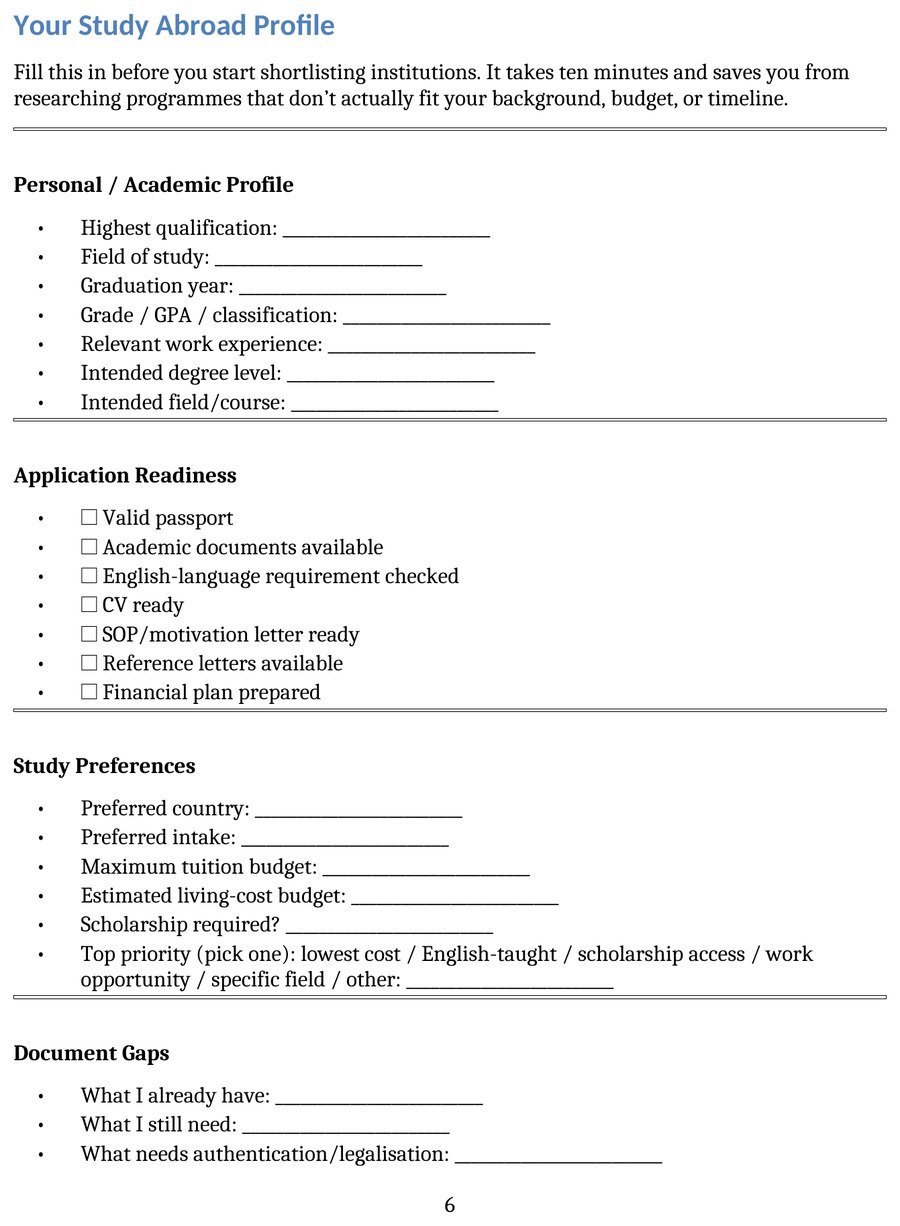
Your Study Abroad Profile
A one-page worksheet to assess your readiness before you start shortlisting institutions.
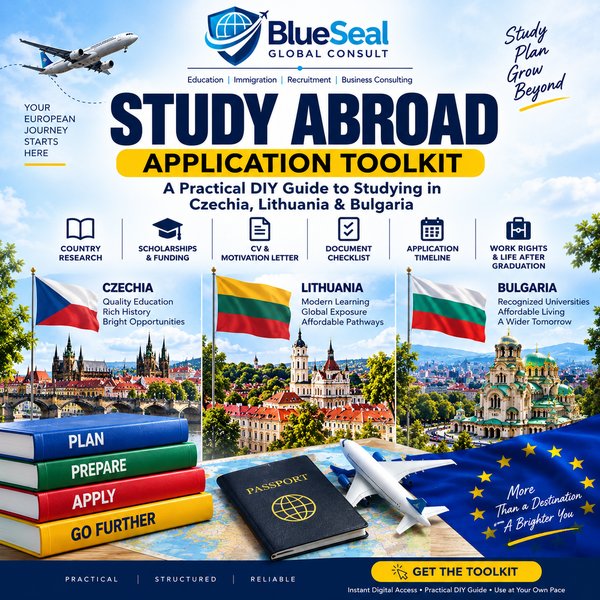
Study Abroad Application Toolkit
Research. Prepare. Verify. Apply. Track.
A structured, step-by-step system to help you organise your profile, research your destinations, prepare your documents, track your applications and verify what matters — before you commit significant money to the process.
 Czechia
 Lithuania
 Bulgaria
You can spend weeks watching videos, searching Google, joining WhatsApp groups and comparing universities — and still not know which destination is realistic, which programmes fit your profile, what documents you need, how to prepare, when to start, what to verify before paying, or what happens after admission.
The problem isn't that information doesn't exist. The problem is knowing what to do with it.
A study-abroad application involves universities, programmes, tuition, scholarships, documents, deadlines, applications, deposits, visas, proof of funds, travel and relocation. Getting the wrong information, missing an important step, or paying before verifying can cost you more than money.
For example, a student with a modest budget may simply be looking at the wrong countries, universities or funding options — because merit-based scholarships and more affordable programmes exist that are easy to overlook without the right information.
You need a process before you need to spend.
So We Put It Into a System
The Toolkit gives you a structured system for moving from "I want to study abroad, but I don't know where to start" to "I understand my profile, I know what to research and prepare, I have a timeline, and I know what to verify before spending money."
A Practical DIY Guide to Studying in Czechia, Lithuania & Bulgaria
This is not simply a PDF full of information. It is a practical application-preparation system.
You do not need to become dependent on an agent simply because you do not know where to start.
Understand your academic and personal profile before choosing destinations and programmes.
Compare countries, institutions and programmes using a structured research process.
Work through your CV, motivation letter/SOP and required documents.
Understand what needs to happen when you begin submitting applications.
Keep deadlines, applications, decisions, deposits and next actions organised.
Check important information and payment requests against official sources before committing money.
Research. Prepare. Verify. Apply. Track.
A structured system, not a generic ebook — your profile, eight practical modules, and a directory of official sources.
A one-page worksheet to assess your readiness before you start shortlisting institutions.
Compare Czechia, Lithuania and Bulgaria with real tuition ranges and anchor institutions, plus a Programme Research Worksheet for each option you consider.
Government scholarships, university awards and EU-funded programmes, with honest guidance on eligibility and where to look.
A widely recognised CV structure for European applications, annotated section by section, with a complete sample CV.
A proven structure, a real annotated example, and the common mistakes that quietly get strong applicants rejected.
Every document you need, organised by stage: university application, authentication and legalisation, proof of funds, and visa.
A realistic, month-by-month planning timeline, plus an Application Tracker for managing more than one institution at once.
Your legal position on working part-time while studying, and how each country's post-study options work, subject to current rules.
How to check that a university, agent or opportunity is legitimate before you send money, plus the red flags that signal a scam.
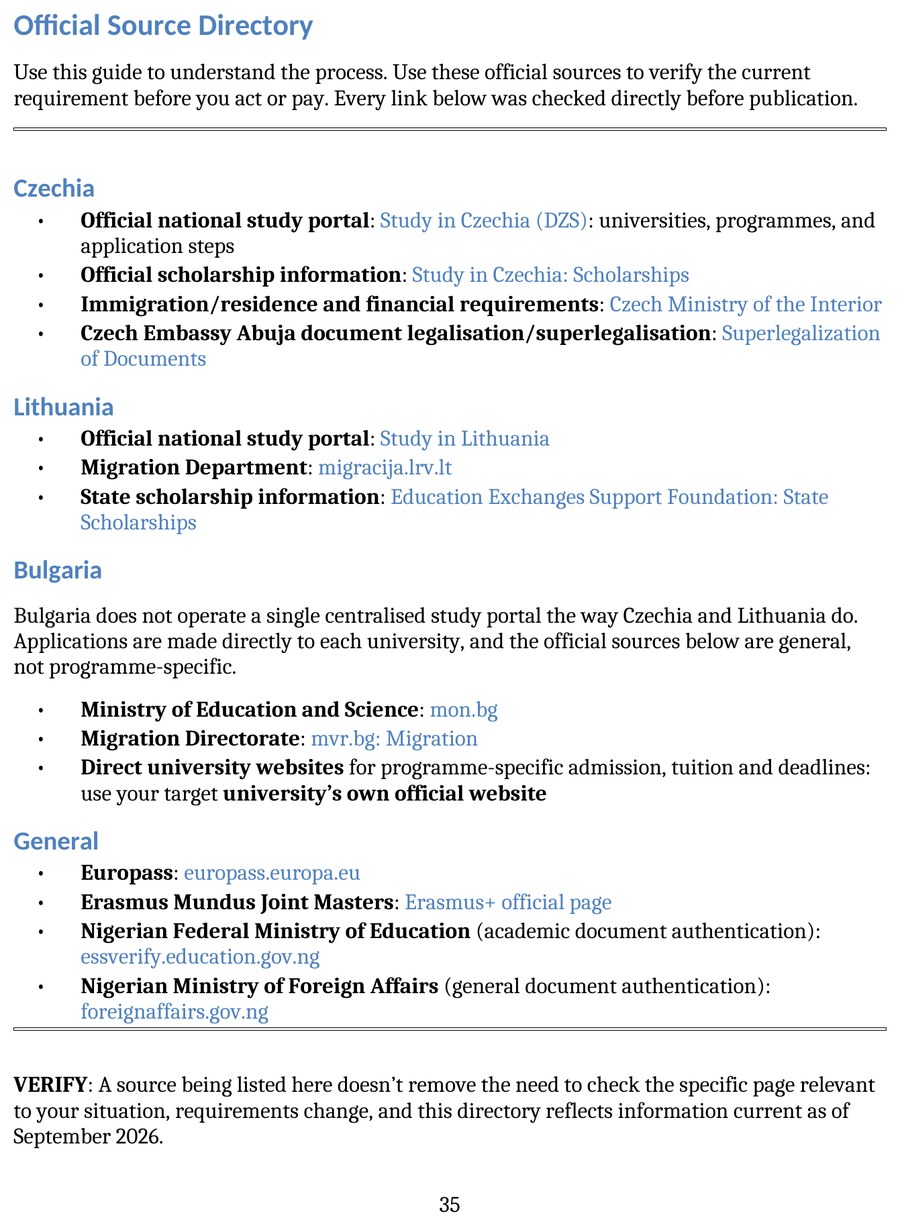
Clickable links to the official government, university and scholarship sources referenced throughout the Toolkit, organised by country.
Not a mockup — actual pages from the Toolkit, so you can see exactly what you're getting.
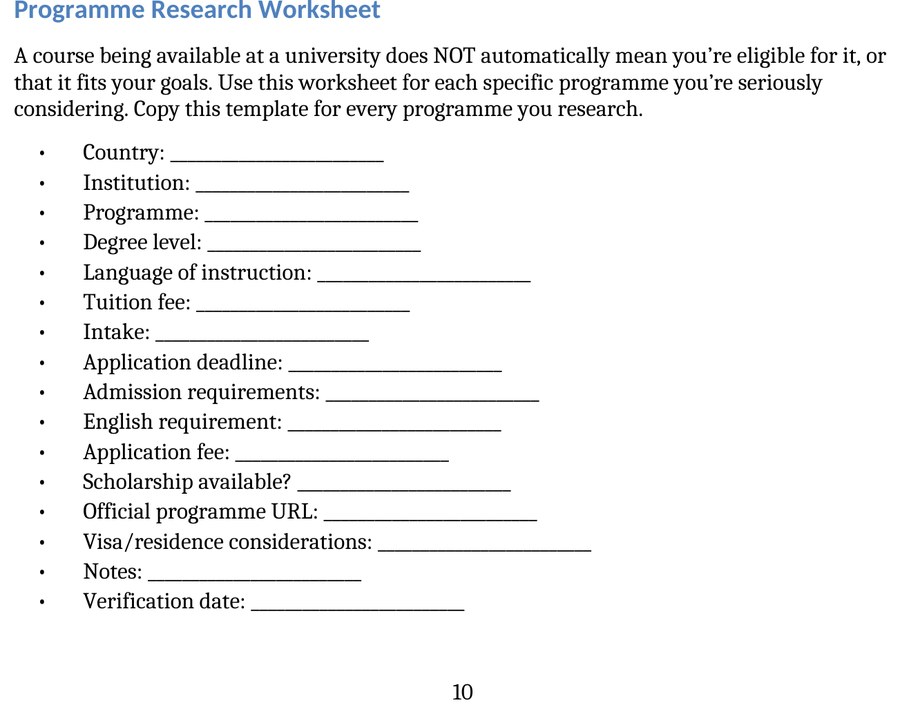
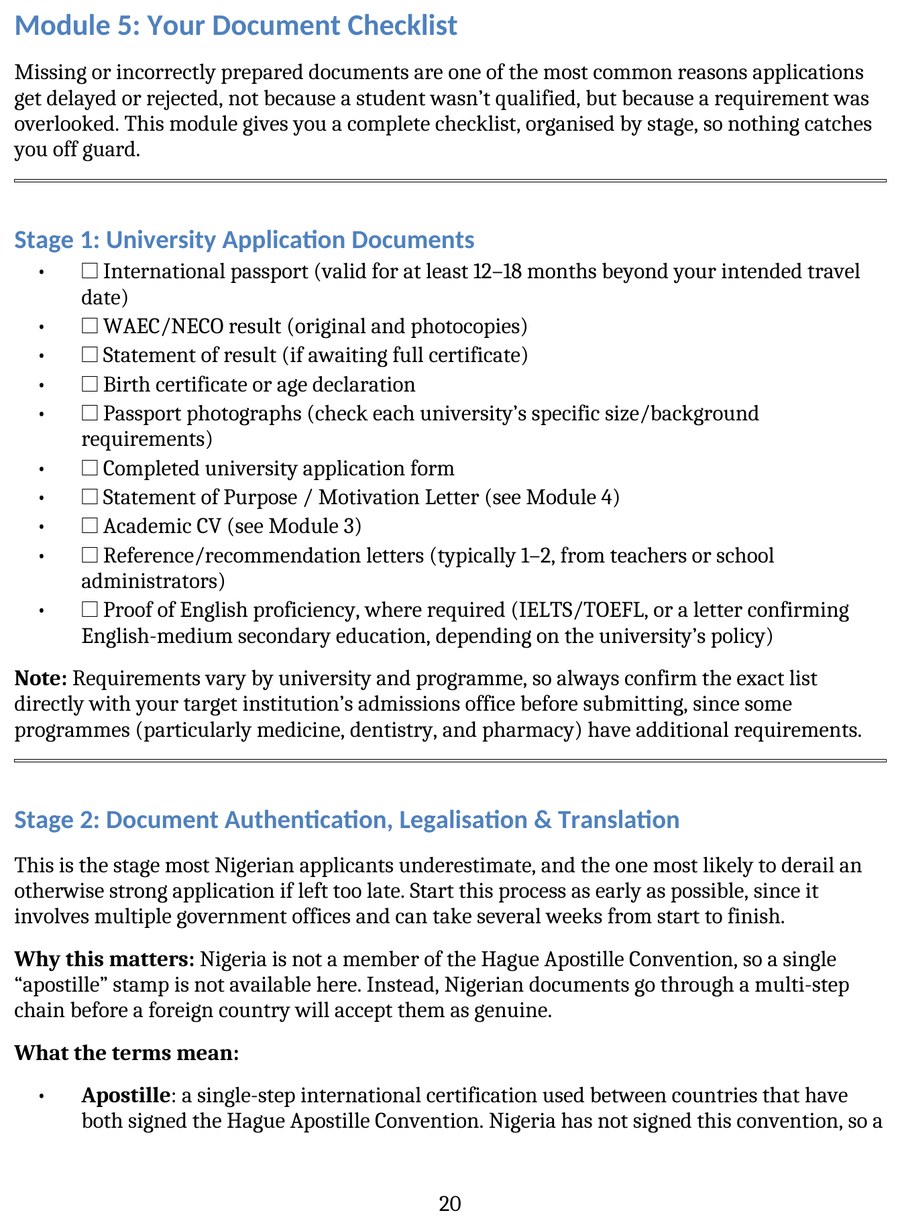
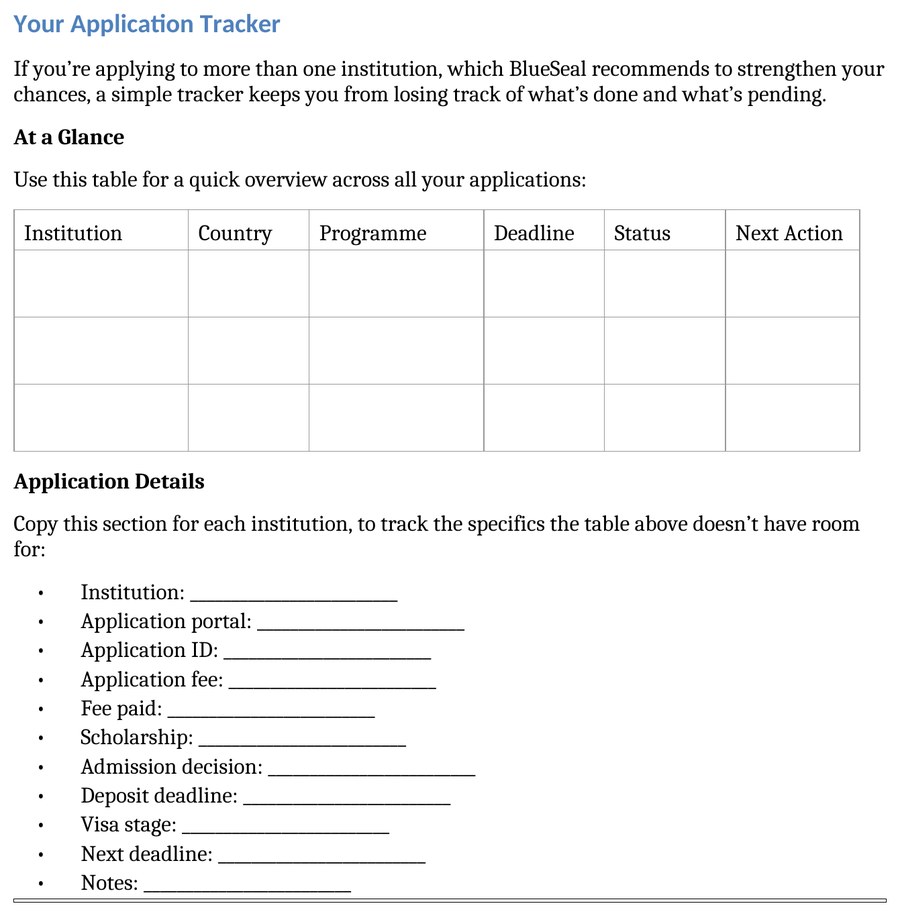
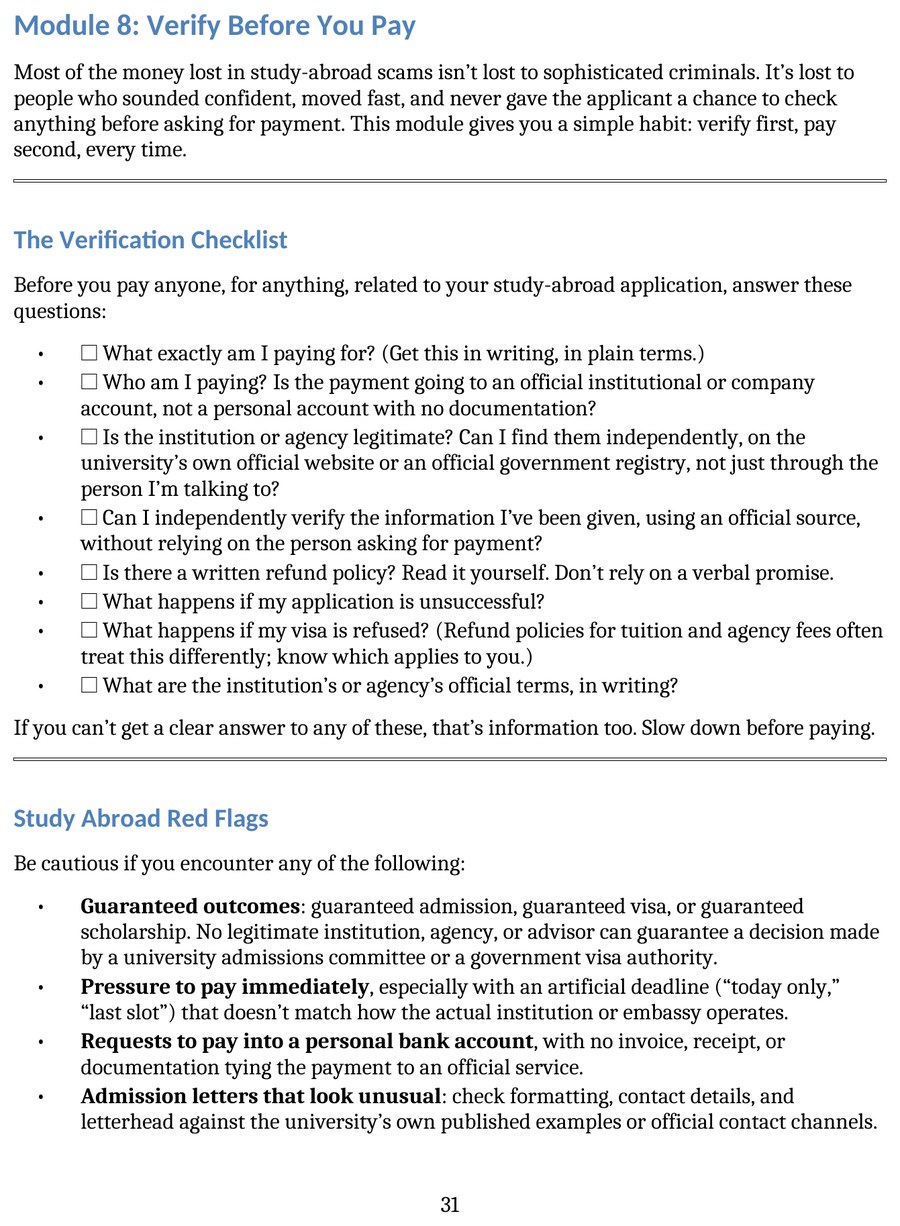
Google can give you information. It won't organise that information into a plan built around your profile, your budget and your timeline. Free information, videos and WhatsApp groups are genuinely useful, and an experienced agent may know the sequence of steps well — none of that is secret knowledge.
Information is not the same as a system for using it.
The Toolkit's value is structure: defining your profile, researching countries and programmes, organising documents, preparing application materials, tracking applications, and verifying information before you pay — all assembled into one usable resource instead of scattered across dozens of tabs and group chats.
"I can find this information online for free" — and much of it, you can. You are not paying for exclusive information. You are paying for the organised framework: a profile worksheet, a country and programme research system, CV and motivation-letter templates, a staged document checklist, an application tracker, and a verification process, assembled into one working resource.
Clarity before commitment.
Czechia, Lithuania and Bulgaria are this edition's affordability-first picks — a focused starting point instead of every possible destination. They are not universally the cheapest, easiest or only destinations BlueSeal can support.
Quality Education · Rich History · Bright Opportunities
Modern Learning · Global Exposure · Affordable Pathways
Recognized Universities · Affordable Living · A Wider Tomorrow
We believe applicants should understand the process before making major financial commitments. Admission decisions belong to institutions. Visa decisions belong to relevant authorities. Scholarship decisions belong to scholarship providers. We don't promise what we cannot control.
A study visa or residence permit is not a work visa. Work rights depend on the destination, immigration status, programme and current law.
Requirements, fees, deadlines and immigration policies can change. Always verify current requirements with the relevant official authority before you act or pay.
Your Investment
A Practical DIY Guide to Studying in Czechia, Lithuania & Bulgaria
The objective isn't simply to download the guide. It's to use it.
Treat this as a working guide, not a one-time read. Work through the modules in order: each one builds on the last, your country choice shapes what scholarships apply to you, your CV feeds into your motivation letter, and both feed into your document checklist and timeline.
Come back to each module as you reach that stage of your actual application — including the work-rights module once you've arrived and settled in, and the verification module before you pay anyone for anything.
A profile filled in once at the start and never revisited stops being useful the moment your circumstances shift.
A downloadable digital Toolkit covering your Study Abroad Profile, eight practical modules (country & university shortlisting, scholarships, CV, motivation letter, document checklist, application timeline, work rights, and verification), plus an Official Source Directory.
Yes. It is a downloadable product delivered through Selar after purchase.
This edition focuses on Czechia, Lithuania and Bulgaria — BlueSeal's affordability-first picks. They are not the only destinations BlueSeal can support.
Yes. The Toolkit is specifically designed as a DIY application-preparation system.
No. No legitimate toolkit, agent or advisor can guarantee a decision made by a university admissions committee or a government visa authority.
Yes. The Country & University Shortlisting module and the Study Abroad Profile are designed to help you narrow this down before you commit to a specific programme.
No. Requirements, fees, deadlines, immigration policies and institutional procedures can change. Always verify current requirements with the relevant official authority.
Most money lost in study-abroad scams isn't lost to sophisticated criminals — it's lost to people who moved fast without checking. Module 8 gives you a simple habit: verify first, pay second, every time.
Use any "Get the Toolkit" button on this page. You'll be taken to the secure Selar checkout to complete your purchase.
This toolkit is an educational and practical preparation resource. It does not guarantee admission, scholarship awards, employment, a work visa, visa approval or residence approval. A study visa or residence permit is not a work visa, and work rights depend on the destination, immigration status, programme and current law. Universities, embassies and immigration authorities make their own decisions, and requirements can change. Always verify current requirements with the relevant university and official government authority before submitting an application.
You don't need to know everything before you begin.
But you should know what to research, what to prepare, what to verify, and when to act.
Plan your study-abroad application before you pay for it.
Research. Prepare. Verify. Apply. Track.
Get the Toolkit